
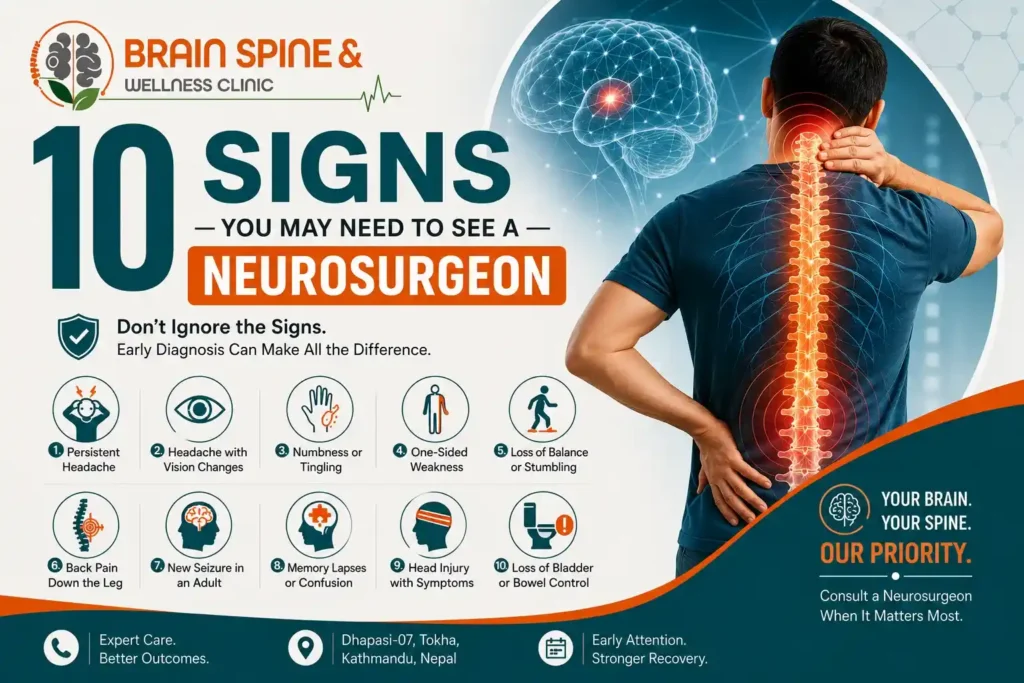
10 Signs You May Need to See a Neurosurgeon
Most headaches, backaches, and tingling sensations are not neurosurgical emergencies. But some are early warnings of conditions needing specialist attention, such as a herniated disc pressing on a nerve or, less commonly, pressure inside the skull. This guide covers 10 symptoms that warrant a neurosurgery consultation, what usually causes each, and when a symptom changes from “wait and see” to “go to the emergency room today.
If any of the signs below sound familiar, it’s worth booking a consultation with a neurosurgeon or spine specialist rather than guessing.
1. A Headache That Won't Go Away After Two Weeks
A headache lasting more than two weeks, or one that keeps returning almost daily, is different from a normal tension headache. Most tension headaches respond to rest, hydration, and over-the-counter medication within a day or two. When a headache outlasts that pattern, it’s time to see a doctor rather than keep reaching for painkillers.
In our experience, patients often wait too long before consulting a doctor for a persistent headache in Kathmandu, assuming it will pass. Sometimes it does. But a chronic daily headache in Nepal can also indicate high blood pressure, sinus problems, medication overuse, or, less often, a structural issue inside the skull that only imaging can confirm.
How to Tell a Normal Headache From a Red Flag Headache
Not every headache needs a neurosurgeon, but a few patterns are worth flagging early. These are commonly called red flag headache signs:
- A morning headache that’s worse when you wake up and eases as the day goes on
- A headache is worse when bending over, coughing, or straining.
- A headache with vomiting, especially without nausea building up first
- A sudden, severe headache unlike any you’ve had before
Comparing tension headaches to brain tumor headaches isn’t reliable at home. Tension headaches usually feel like a tight band around the head and ease with rest. Headaches linked to raised pressure inside the skull tend to be positional, worse in the morning, and don’t respond well to normal painkillers. If your headache follows this pattern, don’t self-diagnose. Book an appointment with a neurologist or neurosurgeon in Kathmandu and let imaging settle the question.
2. Headaches Paired With Vision Changes
Blurred vision, double vision, or a shrinking field of view alongside a headache is a combination that deserves quick attention. This pairing is one of the more recognized brain tumor warning signs, though it’s important to say clearly that most vision changes have far more common causes, like migraines, eye strain, or uncontrolled blood pressure.
What makes this combination different is the mechanism. Vision changes in brain tumor cases usually involve pressure on the optic nerve or the visual pathways in the brain, which is why the change tends to be gradual and one-sided at first, then noticeably worse over weeks. If you’ve noticed your vision shifting alongside headaches that don’t fit a normal pattern, an eye exam alone won’t rule out a neurological cause. Ask for a referral to a neurosurgeon or ask directly for a brain MRI in Kathmandu if your doctor doesn’t suggest one.
3. Numbness or Tingling That Doesn't Go Away
Everyone’s had a foot or a hand fall asleep. That’s normal, temporary, and resolves in minutes once you move. What’s not normal is numbness or tingling that lingers for hours, keeps returning, or spreads from one area to another.
Persistent numbness usually indicates a nerve compressed along its path, whether in the neck, lower back, or a specific nerve in the limb. If numbness is on one side and comes with a headache or weakness, it needs faster attention, as this can indicate a brain problem rather than a pinched nerve. Your doctor will want to know exactly where the numbness starts and spreads, since that pattern often points to the source.
4. One-Sided Weakness or Sudden Difficulty Moving.
Weakness on one side of the body, whether it’s a drooping face, a hand that keeps dropping objects, or a leg that drags slightly when you walk, is never something to wait out. If it comes on suddenly, treat it as a stroke emergency and go straight to the hospital.
If weakness builds gradually over weeks, especially in the hands, along with clumsiness or difficulty with buttons and zippers, it can indicate cervical myelopathy, where the spinal cord is compressed in the neck. Cervical spondylosis myelopathy in Nepal is more common than most realize, especially in patients over 50 with years of neck strain from posture, phone use, or old injuries. Hand weakness linked to a neck problem in Nepal is often overlooked because patients blame it on age or arthritis instead of getting an MRI. Left untreated, spinal cord compression can worsen and become harder to reverse, so early evaluation matters.
5. Loss of Balance or Frequent Stumbling
Struggling to walk in a straight line, stumbling more than usual, or feeling unsteady on stairs is worth mentioning to a doctor, especially if it’s a new pattern rather than something you’ve always had. Inner ear problems cause a lot of balance issues, so that’s usually checked first. But when balance problems appear alongside headaches, vision changes, or slurred speech, they move into the category of brain tumor symptoms in Nepal that warrant imaging rather than a wait-and-see approach.
6. Back Pain That Travels Down Your Leg
This is one of the most common reasons people end up seeing a back pain specialist in Nepal, and it usually has a clear cause. When pain starts in the lower back and radiates down through the buttock, thigh, and sometimes into the foot, that’s sciatica, caused by pressure on the sciatic nerve.
The most frequent cause is a lumbar disc prolapse, where the soft cushion between two spinal bones bulges or ruptures and presses on a nearby nerve root. Depending on the disc affected, this appears as a herniated disc at L4-L5 or L5-S1, the two most common levels for this injury. Leg pain from a back problem in Nepal is often mistaken for a hip or knee issue, especially when the back itself doesn’t hurt much. This mistake is worth avoiding because sciatica treatment in Kathmandu works better when started early, before the nerve is compressed for months.
When Back Pain Is More Than Muscle Strain
Most back pain is muscular and improves within a few weeks with rest, movement, and physiotherapy. A smaller number of cases need a closer look. Ask yourself whether your pain:
- Radiates below the knee, not just into the buttocks
- Comes with numbness or weakness in the foot or toes
- Has lasted more than four to six weeks despite rest and basic treatment
- Started after a fall, accident, or heavy lifting
Wrong diagnosis of back pain in Nepal happens more often than it should, usually because early symptoms are treated as muscle strain without imaging. If your pain fits the pattern above, ask about an MRI instead of continuing painkillers indefinitely. Not every disc problem is a herniation. Foraminal stenosis, where the nerve exit tunnel narrows, and spinal stenosis, where the entire canal narrows, cause similar leg pain but need different treatment. Your neurosurgeon will confirm the difference on MRI, not by symptoms alone.
7.First-Time Seizure in an Adult
A first seizure in an adult in Nepal should always be evaluated urgently, even if the person recovers fully within minutes and seems completely normal afterward. Seizures in children are often linked to fever or epilepsy that runs in families. In adults with no prior history, a new seizure is treated differently because it can be the first visible sign of a structural problem in the brain.
This is where a brain MRI in Kathmandu becomes essential rather than optional. Most first-time seizures in adults turn out to have manageable causes: low blood sugar, alcohol withdrawal, sleep deprivation, or an old head injury. In a smaller number of cases, imaging finds something that needs a neurosurgical opinion, such as an intracranial tumor. Common types include glioma, which arises from the brain’s supporting tissue, and meningioma, a usually slow-growing tumor of the tissue covering the brain. Neither diagnosis is common, and neither should be assumed. That’s exactly why imaging after a first seizure matters more than guessing based on symptoms.
8. Memory Lapses or Sudden Confusion
Occasional forgetfulness happens to everyone, especially under stress or with poor sleep. What’s different is confusion that comes on quickly, memory gaps that are out of character, or difficulty following a conversation you’d normally have no trouble with.
If this follows a head injury, even a mild one from days earlier, it needs prompt evaluation. If it develops on its own, without an obvious trigger, and especially if it comes with a headache that’s worse in the morning, that combination fits the pattern of raised pressure inside the skull. A neurosurgeon will usually order imaging first, since that single test rules in or rules out most of the structural causes far faster than watching symptoms evolve over weeks.
9. A Head Injury With Symptoms That Won't Settle.
Most bumps to the head, even painful ones, settle within a day or two. What needs attention is a head injury where symptoms worsen instead of improving: persistent vomiting, increasing drowsiness, confusion, or a headache that intensifies hours after the injury.This matters even more after road accidents, which remain a common cause of head and spine trauma in Nepal. Emergency neurosurgery in Nepal is most often needed after exactly this kind of injury, when bleeding or swelling inside the skull builds pressure faster than the body can compensate for it. If you or someone you’re with has had a head injury and the symptoms are trending in the wrong direction, don’t wait for a scheduled appointment. Go to the emergency department.
10. Loss of Bladder or Bowel Control With Back Pain.
This is the one symptom on this list that should never wait, not even overnight. Sudden loss of bladder or bowel control, especially paired with numbness in the area you’d sit on (often called saddle numbness) and worsening back or leg pain, can signal cauda equina syndrome.Cauda equina syndrome in Nepal, as elsewhere, is caused by severe compression of the nerve bundle at the base of the spinal cord, usually from a large disc herniation. It’s rare, but it’s a genuine surgical emergency. The window for spinal decompression surgery to prevent permanent nerve damage is measured in hours, not days. If you notice this combination of symptoms, go straight to an emergency room that has neurosurgical cover. Don’t call for an appointment. Go in person.
Choosing the Right Neurosurgeon in Kathmandu
Not all neurosurgical care is the same, and it’s reasonable to ask questions before committing to a treatment plan, especially for spine or brain surgery. A few things worth checking:
- Qualifications
Look for an MS in Neurosurgery from a recognized institution, and confirm the doctor is NMC registered. An NMC-registered neurosurgeon in Nepal has met the country’s formal training and licensing standards. Dr. Suresh Sapkota, who practices at Brain Spine and Wellness Clinic in Kathmandu, holds an MBBS from Kathmandu Medical College under Kathmandu University (2008) and an MS in Neurosurgery from King Edward Medical University in Lahore, Pakistan (2017). - Experience with your specific condition
A spine specialist in the Kathmandu Valley who regularly treats disc herniations will have a different depth of experience than a general surgeon who occasionally handles spine cases. Dr. Sapkota’s practice spans exactly this range, from persistent headaches and disc herniations to nerve compression and complex brain and spine disorders. - Willingness to explain non-surgical options first
A trustworthy neurosurgeon will discuss physiotherapy and conservative treatment honestly, not jump straight to surgery. - Openness to a second opinion
If a major operation is recommended, asking for a second opinion in neurosurgery is a completely normal and reasonable step. A confident specialist won’t discourage it.
Frequently Asked Questions
Most back pain, even with some leg discomfort, can wait for a routine appointment within a week or two. It becomes urgent if you have numbness in the saddle area, loss of bladder or bowel control, or rapidly worsening leg weakness, which requires same-day emergency care.
No. A large share of neurosurgical consultations end with non-surgical treatment, such as physiotherapy, medication, or monitoring. Surgery is typically reserved for cases that don't improve with conservative care or that involve significant nerve compression.
A neurologist diagnoses and manages conditions of the brain, spine, and nerves using medication and non-surgical treatment. A neurosurgeon has the additional training to perform surgery when it's needed, and the two specialties often work together on the same patient.
Yes, in many cases. A herniated disc can shrink and stop pressing on the nerve over weeks to months, especially with physiotherapy and activity changes. Surgery is generally considered when pain persists beyond several weeks, weakness progresses, or nerve compression is severe on imaging.
Consultation fees vary by hospital, the specialist's experience, and whether imaging is needed on the same visit. It's best to confirm the exact fee directly with the clinic or hospital when booking, since prices differ across Kathmandu and Lalitpur.