
Endoscopic Spine Surgery: A Minimally Invasive Approach
Endoscopic spine surgery is a small, keyhole surgery for problems like a slipped disc, sciatica, and spinal stenosis. It uses a tiny camera through a cut of just 8 to 10mm, not a big cut through your back muscles. It’s now available in Kathmandu. Most patients go home the same day.
You’ve had the pain for weeks now. Maybe it shoots down your leg when you sit too long or bend over. Someone may have already mentioned surgery to you. That word alone probably made you want to try one more round of painkillers instead.
That reaction is normal. Most patients picture a big cut, a long hospital stay, and weeks off work. The good news is, that’s not how this surgery works.
Endoscopic spine surgery in Nepal uses a tiny camera through a small cut, about the size of your fingertip. No large cut. No cutting through muscle.
This guide covers how the surgery works, what it treats, how it compares to open surgery, and what recovery looks like. You’ll also meet Dr. Suresh Sapkota, one of the few surgeons in Nepal trained in this technique.
If sitting through a meeting or a car ride has become something you dread, keep reading. You may have more options than you think. When you’re ready, you can book a visit with Brain Spine & Wellness Clinic to talk about your case.
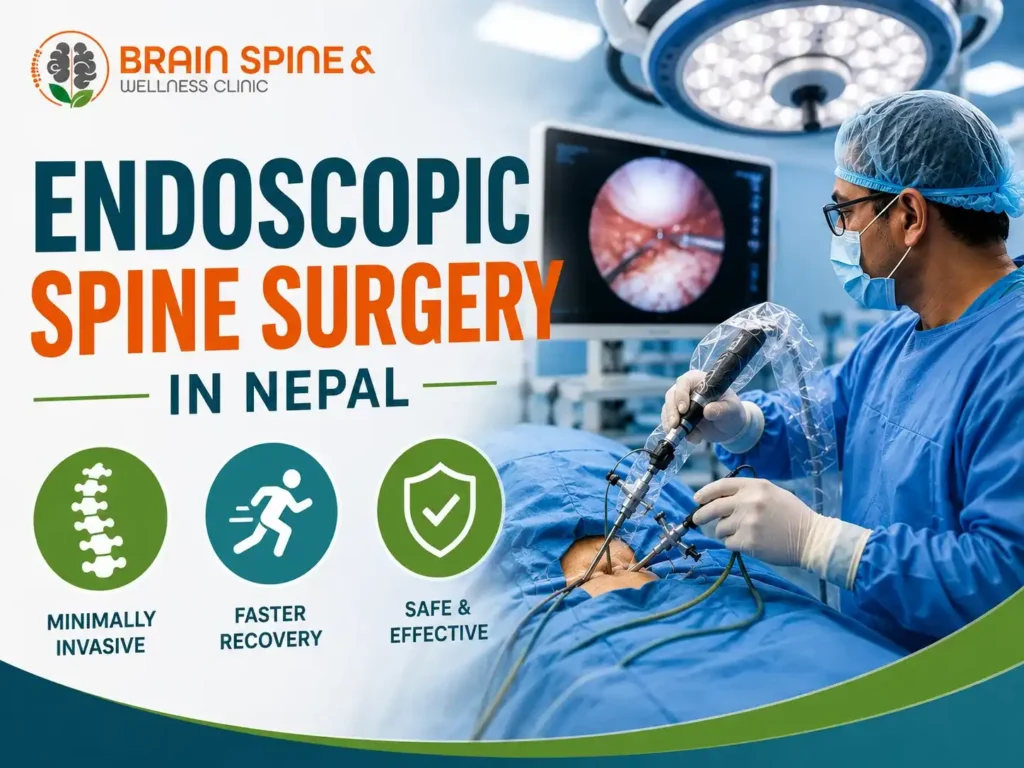
Key Takeaways
- Endoscopic spine surgery uses a small camera through a tiny cut, about 8 to 10mm (less than half an inch). Open surgery needs a much bigger cut, 5 to 10cm (2 to 4 inches).
- It can treat a slipped disc, sciatica (leg pain from a pinched nerve), a narrow spinal canal, and neck disc problems, usually without needing spinal fusion.
- Most patients walk the same day and go back to desk work in 2 to 4 weeks. Open surgery usually takes 2 to 3 months.
- This surgery works well for most patients, helping 80 to 90% of people with a slipped disc.
- Cost in Nepal usually falls between NPR 150,000 and NPR 500,000, roughly 40% less than similar treatment in India.
- Dr. Suresh Sapkota is one of the few Nepal-based surgeons trained in this exact technique. He teaches at the Endoscopic Spine Society of India and works at Kathmandu National Medical College and Blue Cross Hospital.
What Is Endoscopic Spine Surgery?
Endoscopic spine surgery is a type of back surgery that uses a small camera, called an endoscope, put in through a tiny cut, usually 8 to 10mm long. Through that same small opening, the surgeon can see your spine clearly on a screen and fix the problem without cutting through the big muscles in your back.
Here’s how it works, in simple steps. A thin tube holding the camera and small tools is guided right to the damaged disc or the nerve that’s being pinched. The surgeon watches everything on a screen, zoomed in far more than the eye could ever see on its own. The damaged tissue gets removed, and the muscles around your spine are gently pushed to the side instead of cut.
That last part matters more than most people realize. Cutting muscle is a big reason why regular open surgery hurts so much afterward and takes so long to heal.
How is this different from open surgery? Open surgery needs a much bigger cut, often 5 to 10cm (2 to 4 inches), and the surgeon has to cut through muscle to see the spine clearly. That usually means more blood loss, a longer hospital stay, and a slower return to normal life.
How is this different from a microdiscectomy? A microdiscectomy is also a smaller surgery. It uses a microscope instead of a camera. But it still needs a bit of a larger opening, because the surgeon is looking through a scope that sits outside your body, not a camera placed right at the problem. Endoscopic surgery goes one step further and disturbs even less tissue.
Dr. Suresh Sapkota has trained specifically in this technique. He has taught with the Endoscopic Spine Society of India since 2023, which shows a level of skill that not every spine surgeon in Nepal has.
Conditions Treated with Endoscopic Spine Surgery
This surgery can treat many spine problems, from common disc issues to more specific nerve pain. Here are the ones we see most often.
Herniated Disc (Slipped Disc)
A slipped disc, also called a herniated disc, is the most common reason people need this surgery. Your spine has soft discs between the bones that act like cushions. When the soft inside part of a disc pushes out through a small tear, it can press on a nearby nerve and cause pain.
During surgery, the doctor removes only the part of the disc that’s pressing on the nerve. The rest of the healthy disc stays in place. This surgery works well for most patients, and it tends to work even better when treated early. Waiting months while the pain gets worse usually doesn’t help.
Sciatica and Leg Pain
Sciatica happens when a nerve in your lower back gets pinched, sending pain, tingling, or numbness down one leg. It’s one of the most frustrating symptoms patients tell us about, since it makes sitting, walking, and even sleeping hard.
This surgery takes the pressure off that nerve, usually without needing to fuse (permanently join) any bones in your spine. Many patients feel real relief in their leg within days, though soreness where the cut was made can take a bit longer to go away.
Spinal Stenosis
Spinal stenosis means the space inside your spine has become too narrow, which squeezes the nerves inside. It usually develops slowly, often in people over 50, and shows up as pain, weakness, or numbness that gets worse when you walk or stand.
Depending on where the narrowing is, the surgeon can widen that space using the same small-camera method. Not every case of stenosis is a good fit for this, which we’ll explain more below.
Cervical Disc Herniation (Neck Pain with Arm Symptoms)
When a disc in your neck slips, you might feel pain, weakness, or tingling running down your arm instead of your neck. This confuses a lot of patients, who assume the problem is in their shoulder or elbow.
This same small-camera surgery can treat neck disc problems too, through a tiny cut in the neck, avoiding the bigger cut that older neck surgery needs.
Recurrent Disc Herniation
Sometimes a disc slips again in the same spot after an earlier surgery. Scar tissue from that first surgery can make a second open surgery harder and riskier.
This smaller surgery often lets the surgeon work around the old scar tissue more safely than reopening the same area with a big cut.
Facet Joint Cysts and Other Nerve Problems
This surgery can also treat facet joint cysts and a few other, less common causes of nerve pain in the spine. If your MRI shows something unusual and you’re not sure where it fits, that’s exactly the kind of question worth asking at a visit.
Benefits of Endoscopic Spine Surgery
The whole point of this surgery is simple: fix the problem while disturbing as little healthy tissue as possible. Here’s what that means for you in real life.
Smaller Cut, Less Scarring
The cut for this surgery is usually 8 to 10mm, less than half an inch. Open surgery needs a cut of 5 to 10cm, 2 to 4 inches. Besides looking better once healed, a smaller cut also means your body has less damage to recover from.
Less Blood Loss
Blood loss during this surgery is usually very small, sometimes just a few drops. Blood transfusions are rarely needed. That’s a big difference from open spine surgery, where blood loss can be high enough that doctors need to watch it closely.
Muscles Stay Mostly Untouched
Instead of cutting through the muscles that support your spine, the tools used gently spread a path between them. This is a big reason why patients feel less pain and get moving again faster.
Faster Recovery and Return to Work
Many patients walk on the very same day as their surgery. Desk jobs are often possible again within 2 to 4 weeks, compared to 2 to 3 months for open surgery. Getting back to light physical activity also tends to happen sooner, though this depends on the person and the job.
Lower Risk of Infection
A smaller cut gives germs less chance to cause a problem. Infection after this surgery is generally less likely than after open surgery, though good wound care still matters no matter the size of the cut.
Less Need for Strong Pain Medicine
Because there’s less damage to your body, pain after surgery tends to be milder. Many patients only need mild pain relievers instead of strong opioid drugs, which also lowers the risk of side effects from those stronger medicines.
Go Home the Same Day or After One Night
Many patients go home the same day as their surgery. Some stay one night in the hospital just to be watched, especially if the surgery was more complex or if they live far away.
Want to know if this fits your case? Bring your MRI and reports to Brain Spine & Wellness Clinic for a direct review with Dr. Sapkota.
Is Endoscopic Spine Surgery Available in Nepal?
Yes, and more hospitals are offering it every year. You don’t need to travel abroad for this anymore, at least for most common cases.
Minimally invasive spine surgery in Kathmandu is now done at a small number of hospitals that have the right equipment. Dr. Suresh Sapkota is one of the few surgeons in Nepal with real, focused training in this exact technique. That matters a lot, since this surgery depends heavily on the surgeon’s skill and experience working through a camera instead of looking directly with their own eyes.
He works at Kathmandu National Medical College, Blue Cross Hospital, and Brain and Spine Wellness Clinic. Between these three places, the modern equipment needed for this surgery is now available in Nepal, which wasn’t true just a few years ago.
There’s also good news for your wallet. Treatment in Nepal usually costs roughly 40% less than similar surgery in India. That’s made Kathmandu a smart option for patients who might have otherwise needed to travel for care. Think of that number as a general guide, not a fixed price, since your actual cost depends on your specific case.
Who Is a Candidate for Endoscopic Spine Surgery?
Not every back or neck problem needs surgery. And not every surgery case is a good fit for this smaller-cut method. Here’s how we usually think it through.
You may be a good fit if:
- You have a slipped disc causing pain in your leg or arm
- You have certain types of spinal stenosis where the narrowing is in one clear spot
- You’ve tried physical therapy and medicine for 6 to 12 weeks without real improvement
- You specifically want to avoid the longer recovery that comes with open surgery
This surgery may not be right for you if:
- Your spine is very unstable and needs to be fused (joined) for support
- You have narrowing at many levels of your spine in certain cases
- You have severe scoliosis or a major curve or shape problem in your spine
Here’s the thing that trips people up: your symptoms alone can’t tell you which group you’re in. An MRI is a must for every patient, since it shows exactly where the pressure is happening and how bad it is. Two people can have almost the same symptoms but very different MRI results, and that difference often decides the right treatment.If you already have an MRI, bring it to your visit with Dr. Sapkota. He’ll walk you through exactly what it shows and whether this surgery makes sense for you.
What to Expect: The Endoscopic Spine Surgery Process
Knowing what actually happens, step by step, usually eases a lot of the worry around surgery. Here’s the general order of events.
Before Surgery
Your first step is a visit where the surgeon looks at your MRI with you in detail. From there, you’ll get medical clearance and clear instructions to follow beforehand. This usually includes stopping certain blood-thinning medicine ahead of time and not eating the night before.
During Surgery
The surgery itself usually takes 45 minutes to 2 hours, depending on how complex your case is and how many spots in your spine need treatment. You’ll get either full anesthesia (fully asleep) or local anesthesia with sedation (numb and relaxed but not fully asleep), and your surgeon will talk through which one fits your case.
During the whole surgery, the doctor watches a screen showing a clear, zoomed-in view of the disc, nerve, and everything around it. That clear view is a big part of what makes this surgery so precise.
After Surgery
Most patients are walking within a few hours after surgery. You’ll usually go home the same day or the next morning. Pain is normally managed with mild pain relievers rather than strong opioid drugs. You’ll then have follow-up visits at about 1 week, 1 month, and 3 months to check how you’re healing.
Recovery Timeline After Endoscopic Spine Surgery
Recovery doesn’t happen all at once. It’s a step-by-step process, and knowing what to expect at each stage helps you plan your work and daily life.
Timeframe | What to Expect |
Day 1 | Walking and light movement; go home |
Week 1 | Desk work often okay; avoid bending or lifting |
Week 2 to 4 | Slowly do more; physical therapy begins |
Month 2 to 3 | Light exercise, driving, most normal activities |
Month 3 to 6 | Full recovery for most patients |
A few simple things really do speed this up. Physical therapy, good posture, and building strength in your core muscles all help protect your spine while it heals. Skipping these steps just because you feel okay early on is one of the most common mistakes we see.
Call your surgeon right away if you notice a fever, redness or fluid coming from the wound, or your leg getting weaker instead of better. Don’t wait these out.
Endoscopic Spine Surgery Cost in Nepal
Cost is one of the first questions almost every patient asks, and that’s completely fair. A few things affect the final price: which hospital you pick, how experienced the surgeon is, how complex your case is, and what extra tests or imaging you need beforehand.
As a general guide, endoscopic spine surgery in Nepal usually costs somewhere between NPR 150,000 and NPR 400,000. Treat this as a rough estimate, not a fixed price, and confirm your exact cost directly with the clinic once your case has been checked.
This estimate usually covers the surgeon’s fee, your hospital stay, anesthesia, and use of the camera equipment. If you have health insurance, check with your provider directly, since coverage for this kind of surgery can vary a lot between different policies.
Compared to similar treatment in India, spine surgery in Nepal is still much more affordable. That’s one reason more patients are choosing to stay closer to home for care. For a cost estimate based on your own MRI and case, reach out to Brain Spine & Wellness Clinic directly.
Endoscopic vs Open Spine Surgery: A Quick Comparison
Factor | Endoscopic Surgery | Open Surgery |
Size of cut | 8 to 10mm (under half an inch) | 5 to 10cm (2 to 4 inches) |
Muscle damage | Very little (muscles moved aside) | A lot (muscles cut) |
Blood loss | Very little | Moderate to high |
Hospital stay | Same day or 1 night | 3 to 7 days |
Recovery time | 2 to 4 weeks | 2 to 3 months |
Pain medicine | Mild, usually just tablets | Often strong opioid drugs |
Scarring | Very small | Larger, visible scar |
Infection risk | Very low | Higher |
Keep in mind this table shows the general pattern. Your own case, how complex your problem is, and how your body heals can all change these numbers a bit.
Why Choose Dr. Suresh Sapkota for Endoscopic Spine Surgery?
Dr. Suresh Sapkota studied medicine (MBBS) at Kathmandu Medical College and trained further (MS in Neurosurgery) at King Edward Medical University. He is registered with the Nepal Medical Council under NMC 8223. His main focus is brain and spine surgery using this small-camera technique, and he has taught with the Endoscopic Spine Society of India since 2023.
With over 10 years of experience, he works at both Kathmandu National Medical College and Blue Cross Hospital. What patients tell us most, though, isn’t about his qualifications on paper. It’s how he talks to them. He tries non-surgery treatment first and only suggests surgery when it’s truly needed. He also personally explains your MRI results to you, in plain language, so you actually understand what’s going on in your own spine.
If you’re trying to decide what’s right for you and want a clear, honest opinion, you can book a visit at Brain Spine & Wellness Clinic, located in Dhapasi-07, Tokha.
Frequently Asked Questions
Yes. It's a well-known surgery used around the world, with good success and usually fewer problems than open surgery. Like any surgery, safety also depends a lot on picking the right patients and having an experienced surgeon.
Most surgeries take between 45 minutes and 2 hours, depending on the exact problem and how many spots in your spine need treatment.
Most patients who have this disc surgery do not need their spine fused. Fusion is only needed if your spine is significantly unstable, which your surgeon would spot on your MRI beforehand.
It can help if your pain comes from a slipped disc or a pinched nerve that clearly shows up on imaging. If your pain is mostly from muscles, without any nerve involved, non-surgery treatment is usually the better first step.
Right now, it's mostly available at major hospitals inside Kathmandu. Patients from outside the valley usually travel into the city for the surgery and the follow-up visits.
For slipped disc cases, this surgery helps 80 to 90% of patients worldwide. How well it works for you depends a lot on whether you're a good match for it and how experienced your surgeon is.
Desk jobs are often okay again within 1 to 2 weeks. Physical labor usually needs 4 to 6 weeks or more, depending on how hard the job is and how your recovery is going.