Brain Tumor Symptoms and Warning Signs
A headache that won’t quit. A hand that feels clumsier than it used to. A relative who seems a little slower to find words. On their own, none of these feel urgent. Together, or over time, they’re worth paying attention to.
If you’re reading this because something feels off, either for you or for someone you love, this guide covers what to actually watch for, how symptoms change as a tumor grows, what treatment in Nepal looks like today, and what to do next. No panic, just a clear path.
What is a Brain Tumor?
A brain tumor is a mass of abnormal cells growing in or around the brain. Some tumors start directly in brain tissue, called primary brain tumors. Others begin as cancer somewhere else in the body and spread to the brain, called secondary or metastatic tumors.
Not every brain tumor is cancer. Tumors are generally described as benign, meaning they don’t spread to other tissue and usually grow slowly, or malignant, meaning they grow more aggressively and can invade nearby tissue. Because the skull is a closed, fixed space, even a benign tumor can cause real damage over time simply by taking up room and raising pressure inside the head.
Early signs and symptoms
Early brain tumor symptoms are easy to dismiss because they look like ordinary complaints. That’s exactly why so many people miss them for months.
The signs worth tracking:
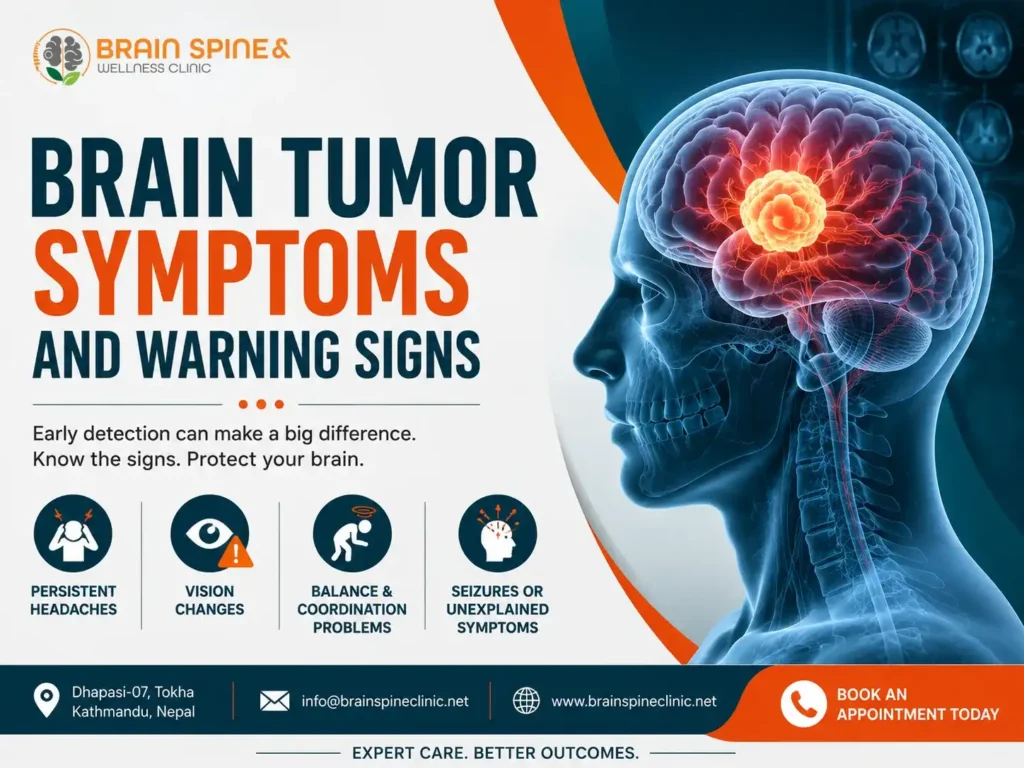
- Headaches that are new, worsening, or worse in the morning
- Nausea or vomiting without a clear cause like food poisoning
- Fatigue that doesn’t improve with rest
- Mild memory lapses or concentration trouble, often noticed by family first
- Slight clumsiness or balance changes
- Blurred vision or occasional double vision
None of these alone means much. A stressful month can cause half this list. What matters is whether a symptom is new, sticking around past two to three weeks, or showing up alongside another one. A headache that resists paracetamol and wakes you at night is a different signal than a headache after a long day at a screen.
Advanced signs and symptoms
As a tumor grows or presses on more brain tissue, symptoms tend to become harder to ignore and more specific to where the tumor sits.
Watch for:
- Seizures, especially a first seizure in someone with no prior history
- Sudden weakness or numbness on one side of the body
- Noticeable speech difficulty or trouble understanding others
- Vision loss or missing sections of your visual field
- Sudden, severe confusion or personality change
- Loss of balance severe enough to affect walking
- Persistent vomiting alongside a worsening headache
A red flag for a brain tumor is any sudden neurological change, a first seizure, one sided weakness, sudden vision loss, or severe confusion that comes on quickly. These aren’t symptoms to monitor at home. They’re symptoms that need same day medical attention, ideally at an emergency department with neurology or neurosurgery on call
Symptoms Based On The Tumor's Location
The brain isn’t one uniform organ. Different regions handle different jobs, so where a tumor sits shapes what kind of symptoms show up first.
Frontal lobe. Controls personality, planning, and movement. Tumors here often cause personality changes, poor judgment, or weakness on one side of the body before any obvious physical symptom appears.
Temporal lobe. Handles memory and language comprehension. Tumors here commonly cause memory problems, seizures, or trouble understanding speech.
Parietal lobe. Manages sensation and spatial awareness. Tumors here can cause numbness, coordination trouble, or difficulty reading and writing.
Occipital lobe. Processes vision. Tumors here tend to cause vision loss, blind spots, or visual hallucinations, often the first symptom patients notice.
Cerebellum. Controls balance and coordination. Tumors here typically cause clumsiness, unsteady walking, or dizziness.
Brainstem. Regulates basic life functions and cranial nerves. Tumors here can cause swallowing difficulty, facial numbness, double vision, or changes in breathing, and tend to be treated with particular urgency given the brainstem’s role.
Treatment Options Available in Kathmandu
Treatment depends on the tumor’s type, size, grade, and location, along with the patient’s age and health. Most patients are cared for by a team that includes a neurosurgeon, oncologist, and rehabilitation specialists.
Surgery
For many brain tumors, surgery is the first step. The goal is to remove as much of the tumor as safely possible while protecting healthy brain function. Kathmandu has neurosurgeons experienced in modern techniques, including image-guided and endoscopic surgery, which helps remove tumor tissue precisely while avoiding critical areas of the brain. Dr. Suresh Sapkota, for example, specializes in endoscopic brain and spine surgery, an approach that can mean smaller incisions and a smoother recovery for many patients
Radiation Therapy
Radiation uses focused energy beams to damage tumor cells and stop them from growing. It may be used after surgery to target remaining cells, or as a main treatment when surgery isn’t possible.
Chemotherapy
Chemotherapy uses medication to kill cancer cells or stop them from dividing. It isn’t needed for every tumor, but it plays an important role for certain aggressive types.
Rehabilitation
Treatment doesn’t end after surgery or radiation. Depending on which brain functions were affected, patients may need:
- Physiotherapy – to rebuild strength and balance
- Occupational therapy – to relearn daily tasks
- Speech therapy – to support language and swallowing
Rehabilitation services are increasingly available in Kathmandu, helping patients recover as fully as possible after treatment
On cost: brain tumor treatment cost in Nepal varies a lot depending on the type of surgery, whether radiation or chemotherapy is needed, and which hospital you choose. As a rough reference point, a hospital official was cited in 2025 news coverage giving a surgery cost range of roughly NPR 100,000 to 300,000, a figure from a single report rather than a published price list. Separately, a Kathmandu-based cancer centre has stated that comparable treatment in Nepal generally costs around 40 percent less than the same quality of care in India, a claim from a provider’s own site rather than an independent comparison. Treat both figures as rough context, not a quote. Exact costs should always be confirmed directly with the treating hospital, since they depend heavily on individual diagnosis and treatment plan.
If you’re looking for the best neurosurgeon in Kathmandu or a brain tumor specialist in Nepal, start with a referral from a neurologist or your primary doctor, ask directly about the surgeon’s experience with your specific tumor type, and don’t hesitate to get a second opinion for anything beyond a routine, low risk case. At Brain Spine & Wellness Clinic, our team works alongside Kathmandu’s neurosurgical centres to guide patients from first symptom through diagnosis, treatment, and follow up care.
What to do if you have signs or symptoms
If any of the early signs above have lasted more than two to three weeks, or if you notice more than one at the same time, book an appointment. Bring notes on when symptoms started, how they’ve changed, and anything a family member has noticed.
If you have any red flag symptoms, a first seizure, sudden weakness, sudden vision loss, or severe sudden confusion, go to an emergency room immediately. Don’t wait for a scheduled appointment.
The typical next step is a neurological exam followed by an MRI, the standard imaging for detecting brain tumors. Brain tumor MRI in Nepal is available at most major Kathmandu hospitals, usually with same week scheduling. If the MRI shows something abnormal, you’ll typically be referred to a neurosurgeon or neuro-oncology team for next steps, which may include a biopsy to confirm the tumor type before deciding on treatment.
Not sure whether your symptoms need a scan? Reach out to Brain Spine & Wellness Clinic and we’ll help you figure out the right next step, without assuming the worst before you have real answers.
Common Myths About Brain Tumors
Myth: All brain tumors are cancer. False. Many brain tumors, like most meningiomas, are benign.
Myth: A brain tumor is always fatal. False. Many patients, especially those with benign or low-grade tumors, live long, healthy lives after treatment.
Myth: Headaches always mean a brain tumor. False. Most headaches are caused by far more common conditions like stress, tension, or migraines.
Myth: Brain tumor treatment isn’t available in Kathmandu. False. Many patients now receive full diagnosis and treatment, including surgery, right here in Kathmandu, without needing to travel overseas.
Meet Dr. Suresh Sapkota: A Leading Neurosurgeon in Kathmandu
Dr. Suresh Sapkota is a Senior Consultant Neurosurgeon and Endoscopic Spine Surgeon at Kathmandu National Medical College, Ghattekhulo, and Blue Cross Hospital, Tripureshwor. He holds an MBBS from Kathmandu Medical College and an MS in Neurosurgery from King Edward Medical University, and is registered with the Nepal Medical Council as NMC 8223.
He specializes in brain tumor surgery, spine surgery, and endoscopic techniques that can mean less tissue damage and faster recovery for many patients. Known for his clear communication, Dr. Sapkota is widely regarded as one of the best neurosurgeons in Kathmandu for brain tumor and spine care. His approach to endoscopic surgery, along with how he guides patients through diagnosis and recovery, is something he speaks about in his own words, and it’s also reflected in the way he works with patients at Brain Spine Clinic, where his team can walk you through next steps if you’d like to be seen.
What to Ask Your Neurosurgeon
Walking into a consultation can feel overwhelming, especially when you’re anxious. It helps to write your questions down beforehand. Some useful ones include:
- What type and grade is this tumor?
- Is it benign or malignant?
- What are the treatment options, and what do you recommend?
- What are the risks and benefits of surgery?
- How long is the recovery expected to take?
- Will I need radiation or chemotherapy after surgery?
- What follow-up scans or visits will I need afterward?
- Are there support resources available for me or my family?
There’s no such thing as a silly question. A good neurosurgeon will take the time to explain things clearly and make sure you feel informed before making any decisions. This is exactly the approach Dr. Suresh Sapkota is known among his patients in Kathmandu.
Frequently Asked Questions
New or worsening headaches, unexplained nausea, fatigue that doesn't improve with rest, and memory or concentration changes that others notice first.
See a doctor if a symptom is new or persists past two to three weeks. They'll do a neurological exam and order an MRI if warranted, which is how brain tumors are actually detected.
They can occur at any age, including in children. Diagnosis rates are highest in adults between roughly 65 and 74, though some tumor types are more common in younger people.
A general cancer checklist, not brain tumor specific: a change in bowel or bladder habits, a sore that doesn't heal, unusual bleeding, a new lump, indigestion or trouble swallowing, a changing wart or mole, and a nagging cough or hoarseness.
Not reliably, and not as a standard clinical test today. Imaging, mainly an MRI, is still the standard way to detect one.
No, not universally. Many benign tumors are curable with surgery. Some malignant ones respond well to treatment, others are harder to cure completely, so outcomes depend heavily on tumor type and grade.
It varies. Slow growing tumors can take months or years to cause noticeable symptoms, while fast growing ones can cause symptoms within weeks.
Sources
- News coverage on a Kathmandu hospital’s brain tumor surgery initiative, for the NPR 100,000 to 300,000 surgery cost reference and confirmation of a national brain tumor centre: link
- A national brain tumor centre’s own site, for its 2023 establishment: link
- A Kathmandu cancer centre’s overview page, for which hospitals in the city perform brain tumor neurosurgery: link
- The same cancer centre, for the cost comparison with India: link
- A Kathmandu hospital’s neurosurgery department page, for confirmation that neurosurgery is offered locally: link