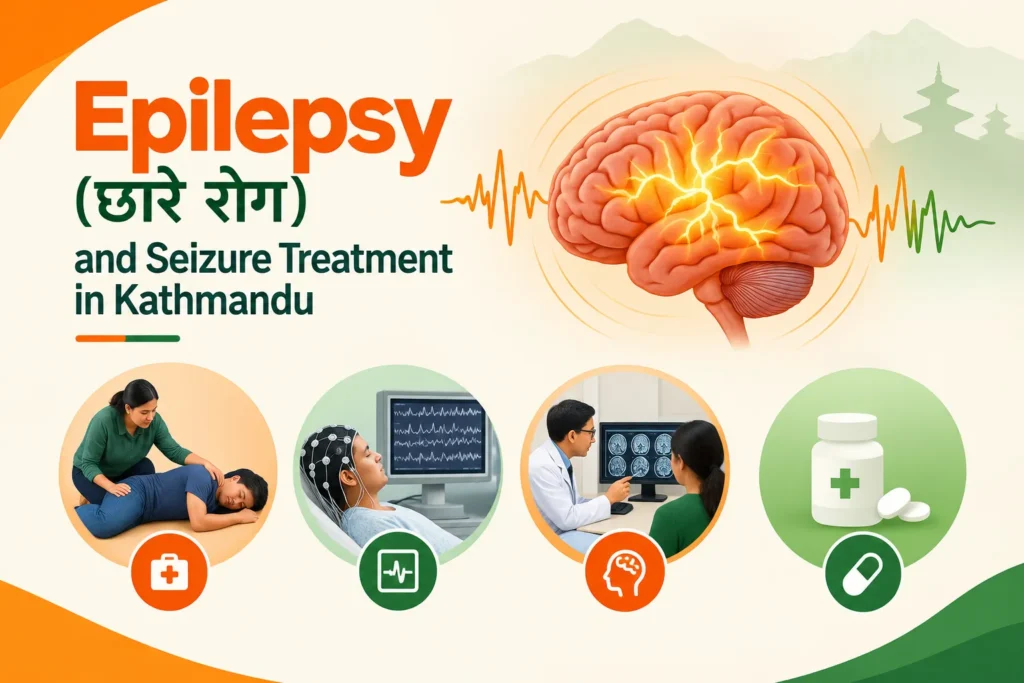
Epilepsy (छारे रोग) and Seizure Treatment in Kathmandu
Epilepsy (छारे रोग) is a brain condition that causes repeated seizures (दौरा). It’s not caused by evil spirits, it’s not contagious, and in most cases it can be managed well with the right treatment, from medication through to surgery for select patients.
What Is Epilepsy?
- Epilepsy is a brain disorder that causes seizures to happen again and again, without a clear outside cause.
- A seizure happens when there’s a sudden burst of abnormal electrical activity in the brain.
- Doctors usually call it epilepsy after a person has had two seizures that happen without a clear cause, or one seizure with a high chance of having another.
- It can affect anyone, at any age, but is most often diagnosed in young children and older adults.
Is Epilepsy the Same as a Seizure?
No, this is something many people misunderstand.
- A seizure is a single event: one episode of abnormal brain activity.
- Epilepsy is the underlying condition that causes seizures to happen repeatedly.
- You can have a seizure without having epilepsy — for example, from a high fever, low blood sugar, or a head injury.
- Epilepsy is diagnosed when seizures keep happening without a clear outside cause.
Types of Epilepsy and Seizures
Focal Onset Seizures
These start in one specific area of the brain.
- Focal aware seizures: The person stays conscious and aware during the seizure, though they may have unusual movements, sensations, or emotions.
- Focal impaired awareness seizures: Awareness is affected — the person may seem confused, stare blankly, or not respond normally during the episode.
- Focal to bilateral seizures: A seizure that starts in one area and then spreads to involve the whole brain, becoming a tonic-clonic seizure.
Generalised Onset Seizures
These involve both sides of the brain from the start.
- Absence seizures: Short episodes where a person stares into space for a few seconds and does not respond.
- Tonic-clonic seizures: The most recognisable type, the body stiffens, then jerks, often with loss of consciousness.
- Atonic seizures: The muscles suddenly lose strength, which can make the person fall.
- Clonic seizures: Repeated, rhythmic jerking movements.
- Tonic seizures: Sudden muscle stiffening.
- Myoclonic seizures: Quick, sudden muscle jerks that happen fast.
What Causes Epilepsy?
Epilepsy can develop for several reasons:
- Brain tumour
- Stroke
- Head injury from an accident
- Brain damage at birth
- Abnormal electrical activity in brain cells, with no visible structural damage
- Genetic factors
Epilepsy can start at any age, but it’s more common at the extremes, in young children and in older adults. Many children with epilepsy outgrow it as they get older. With guidance from experienced neurosurgeons and neurologists in Nepal, treatment outcomes have improved significantly in recent years.
Epilepsy Risk Factors
- Family history of epilepsy
- Injury around the time of birth (perinatal injury)
- Previous head trauma
- Vascular (blood vessel) diseases affecting the brain
- Infections affecting the brain and spinal cord
- Age, young children and older adults are at higher risk
What Are the Symptoms of Epilepsy?
- Staring into space for a short time
- Uncontrolled jerking movements of the arms and legs
- Sudden stiffening of the body
- Loss of consciousness or awareness
- Sudden falls with no clear cause
- Unusual sensations, such as strange smells, tastes, or feelings, before a seizure
- Confusion for a period after a seizure
How Is Epilepsy Diagnosed?
- Neurological examination and medical history: The doctor reviews your symptoms, seizure pattern, and general health.
- Electroencephalogram (EEG): Records the brain’s electrical activity to look for abnormal patterns.
- Imaging studies: MRI or CT scans check for structural causes, such as a tumour or old injury.
- Blood tests: Help rule out other causes, like an infection or metabolic issue.
First Aid: What to Do During a Seizure
This is useful to know even if no one in your family has epilepsy. You may need it to help someone else one day.
- Stay calm, and stay with the person.
- Gently turn them onto their side to help keep their airway clear.
- Place something soft under their head.
- Move nearby objects out of the way so they don’t get hurt.
- Check how long the seizure lasts.
- Do NOT put anything in their mouth — this is a myth, and it can cause injury.
- Do NOT hold the person down or try to stop their movements.
- Call for emergency help if the seizure lasts more than 5 minutes, if another seizure follows right after, or if the person is injured, pregnant, or doesn’t regain awareness afterward.
Common Seizure Triggers
Not everyone has identifiable triggers, but common ones include:
- Missed doses of seizure medication
- Lack of sleep
- Significant stress
- Flashing or flickering lights, in some people
- Alcohol or recreational drug use
- Fever or illness
- Hormonal changes
Epilepsy Treatment in Kathmandu
Can Epilepsy Be Treated?
Yes. Most people with epilepsy achieve good seizure control with the right medication. For those who don’t respond to medication, other options, including surgery, may be considered.
How Long Does Someone Need to Stay on Medication?
This varies by individual. Some people can eventually reduce or stop medication under close medical supervision, usually after being seizure-free for a few years. This decision should always be made together with your doctor, not alone.
Can Epilepsy Be Cured With Brain Surgery?
For a specific group of patients, particularly those with focal epilepsy that hasn’t responded to medication, surgery can significantly reduce or even stop seizures. It is usually not the first treatment tried, and it is not right for everyone, it’s considered only after careful evaluation.
Who Needs a Presurgical Evaluation?
Epilepsy centers generally consider surgical evaluation for patients who:
- Have had epilepsy for more than two years
- Experience two or more disabling seizures per month
- Haven’t responded to medication, despite trying two appropriate anti-epileptic drugs (AEDs), either as separate monotherapies or in combination, which is the standard clinical definition of drug-resistant epilepsy
- Have serious side effects from their seizure medicines
Myths and Facts About Epilepsy
- Myth: Epilepsy is caused by evil spirits, and sufferers need a tantrik or spiritual healer.
Fact: Epilepsy comes from abnormal electrical activity in the brain. It needs a qualified doctor, not spiritual treatment.
- Myth: Epilepsy is contagious — never touch someone having a seizure.
Fact: It is not contagious in any way. Someone having a seizure needs your help, not distance.
- Myth: Epilepsy in the family is a shameful secret.
Fact: It isn’t a stigma, and open, accurate knowledge helps reduce the stigma around it.
- Myth: Epilepsy is a form of madness and should be treated in an asylum.
Fact: It’s a brain condition, treated by physicians and neurologists — not a mental illness.
- Myth: Children with epilepsy can’t learn and shouldn’t go to school.
Fact: Epilepsy doesn’t limit intelligence. With proper treatment, most children with epilepsy learn and achieve normally. It’s the stigma, not the condition, that usually keeps them out of school.
- Myth: Women with epilepsy can’t marry or have children.
Fact: Women with epilepsy can safely marry and have children, with appropriate specialist care during pregnancy.
- Myth: Putting a key or shoe near the person, or making them smell onions, stops a seizure.
Fact: None of this works. Most seizures stop on their own within a couple of minutes. Turn the person to their side and cushion their head instead.
- Myth: Marriage cures epilepsy.
Fact: Marriage has no effect on epilepsy or its treatment.
Why Choose Brain Spine & Wellness Clinic for Epilepsy Treatment in Kathmandu
KNMC’s epilepsy care is organized to support patients at every stage:
- Children and adults with epilepsy
- Patients with a first-time seizure or newly diagnosed epilepsy
- Patients with epilepsy that’s been difficult to control with medication
- Patients being evaluated for epilepsy surgery
Meet Dr. Suresh Sapkota, Neurosurgeon in Kathmandu
Dr. Suresh Sapkota is a Senior Consultant Neurosurgeon at Brain Spine & Wellness Clinic (NMC 8223), specializing in brain surgery, spine surgery, and endoscopic neurosurgical techniques.
- Education: MBBS, Kathmandu Medical College (2002–2008); MS in Neurosurgery, King Edward Medical University, Lahore, Pakistan (2012–2017)
- Current roles: Senior Consultant Neurosurgeon at Brain Spine & Wellness Clinic ; President-Elect, Nepalese Society of Neurosurgeons (NESON)
- Also practices at: KNMC Hospital Kathmandu
Dr. Sapkota is known for explaining scans and treatment options clearly, so patients understand their condition and choices before deciding on any treatment, including surgery. Book an appointment with Dr. Sapkota.
FAQs
Is epilepsy curable?
Many people achieve full seizure control with medication, meaning their seizures stop happening, even though the condition itself may still be present underneath. For select patients, surgery can significantly reduce or stop seizures.
Can a person with epilepsy live a normal life?
Yes. With proper treatment, most people with epilepsy work, study, marry, and raise families normally.
Is epilepsy hereditary?
It can run in families in some cases, but many people with epilepsy have no family history at all. Causes vary widely.
What should I do if someone near me has a seizure?
Stay calm, turn them onto their side, cushion their head, and time the seizure. Don’t put anything in their mouth or hold them down. Call for emergency help if it lasts more than 5 minutes.
When should epilepsy be evaluated for surgery?
Generally after medication with two appropriate anti-epileptic drugs hasn’t controlled the seizures, this is the standard definition of drug-resistant epilepsy used to guide referral for surgical evaluation.
- ILAE — Operational Classification of Seizure Types (Fisher et al., 2017) ·
- ILAE — Drug-Resistant Epilepsy
Consult Doctor: Dr Suresh Sapkota, Senior Consultant Neurosurgeon (NMC 8223)
Book a consultation with Brain Spine & Wellness Clinic, Neuro-Surgery team:
Book Appointment: 9709087879 | Contact Us
Follow Dr Suresh Sapkota: Facebook | Instagram | LinkedIn | TikTok
Medically reviewed by Brain Spine & Wellness Clinic Last updated: September 2026
This article is intended for general educational purposes and does not replace professional medical advice, diagnosis, or treatment. If you or someone you know is experiencing seizures, please consult a qualified doctor for a proper evaluation.