Neurosurgeon in Kathmandu,How to Find a Specialist You Can Trust.
Neurosurgery is one of the most challenging fields in medicine. The brain and spinal cord are very complex, so they need both skilled hands and good judgment. The right surgeon can help you move again, ease pain, and sometimes even save your life. The wrong choice can lead to serious problems.
The good news is that Kathmandu now has more qualified neurosurgeons who have trained internationally. Nepal’s hospitals have improved a lot in the last twenty years, so you no longer need to go abroad for reliable neurosurgical care. You just need to know what to look for.
What Exactly Does a Neurosurgeon Do?
People often mix up neurologists and neurosurgeons, but the difference is important. A neurologist treats brain, spine, and nerve problems with medicine and therapy, but does not do surgery. A neurosurgeon is trained to operate on the brain, spinal cord, and related areas when other treatments are not enough.
Conditions that commonly bring patients to a neurosurgeon include:
- Brain tumors, whether benign or malignant
- Spinal disc herniation, including lumbar and cervical disc problems
- Cerebral aneurysms and vascular malformations
- Epilepsy that does not respond to medication
- Severe head trauma and traumatic brain injuries
- Hydrocephalus, a build-up of fluid in the brain
- Pituitary tumors
- Spinal stenosis and degenerative spine disease
Not every consultation with a neurosurgeon ends in surgery. A good neurosurgeon assesses whether an operation is necessary, considers less invasive options first, and is transparent about the risks and benefits of each option.
Why Finding the Right Neurosurgeon Matters More Than You Think.
Neurosurgery is known as one of the most difficult areas in medicine. Surgeons work in tiny spaces, often near parts of the brain that control movement, speech, memory, and breathing. In this field, experience is more than just a qualification it has a real impact on results.
A surgeon who has performed a specific procedure dozens or hundreds of times makes decisions during an operation that a less experienced surgeon cannot. They recognize complications earlier, know when to stop and reconsider, and handle unexpected findings with greater composure. Volume and experience matter here.
Nepal’s healthcare system has gotten much better in recent years. Now, several well-trained neurosurgeons work in Kathmandu’s top hospitals, which have modern equipment and ICUs. The main challenge is not finding qualified care, but knowing how to choose the right surgeon.
Choosing based solely on cost or convenience, without checking qualifications, registration, or surgical experience, carries real risk. This is not to alarm you but to help you ask the right questions before making one of the most important healthcare decisions you will face.
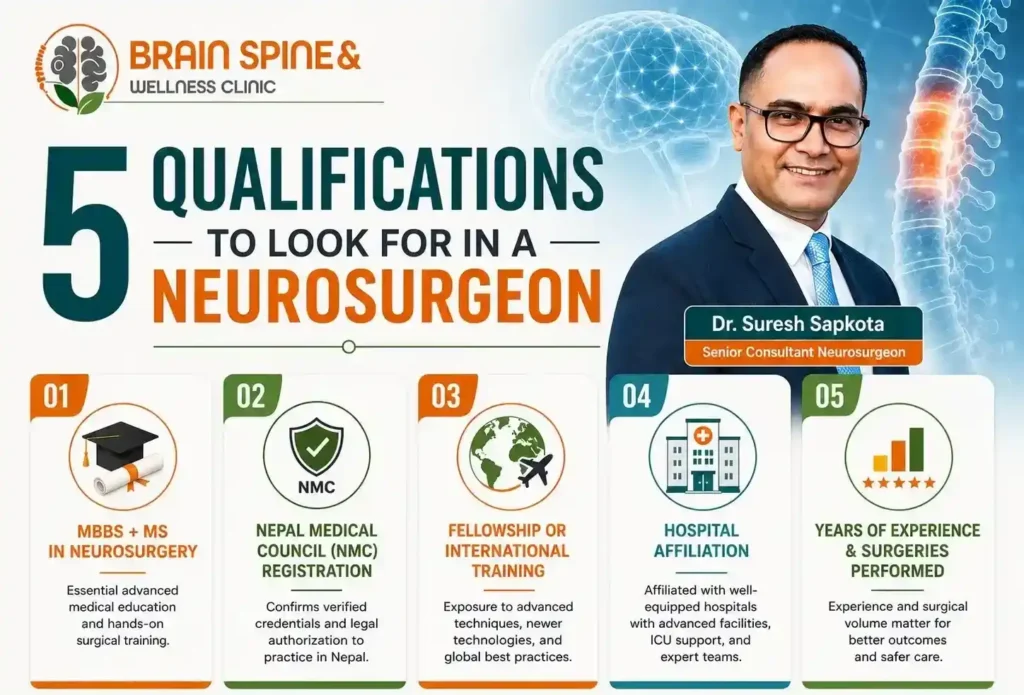
5 Qualifications to Look for in a Neurosurgeon
1.MBBS + MS in Neurosurgery
A neurosurgeon must hold a basic medical degree (MBBS) followed by a specialized postgraduate qualification in neurosurgery, typically an MS (Master of Surgery) in Neurosurgery. This training takes five to six years beyond the MBBS and includes hands-on surgical training under supervision. Anyone performing neurosurgical procedures without these degrees has not completed the standard pathway and should not be trusted with complex cases.
2. Nepal Medical Council (NMC) Registration
Every licensed medical practitioner in Nepal must be registered with the Nepal Medical Council. This confirms the doctor’s credentials have been verified, they meet the standards to practice in Nepal, and are accountable to a regulatory body. Before booking a consultation, ask for the doctor’s NMC number. You can verify it through the NMC’s official online portal. A doctor reluctant to share this information is a warning sign.
3. Fellowship or International Training
Neurosurgery evolves continuously. Surgeons who complete fellowships or additional training abroad, especially in centers known for neurosurgical excellence, gain exposure to advanced techniques, newer technologies, and a broader perspective on complex cases. This is especially important for subspecialties like endoscopic spine surgery, skull base surgery, or functional neurosurgery.
4. Hospital Affiliation
A qualified neurosurgeon should be affiliated with hospitals that offer advanced imaging, modern operating theatres, ICU support, and experienced multidisciplinary teams. Dr. Suresh Sapkota currently serves as a Senior Consultant Neurosurgeon at Kathmandu National Medical College, Ghattekhulo, Kathmandu, and Blue Cross Hospital, Tripureshwor, Kathmandu, where he specializes in endoscopic brain and spine surgery. These affiliations ensure patients have access to comprehensive neurosurgical care and modern treatment facilities.
5. Years of Experience and Number of Surgeries Performed
Ask how many years the surgeon has practiced independently and how many times they have performed your specific procedure. A surgeon with seven or more years of experience and substantial operative volume is in a better position than someone recently out of training, especially for complex or high-risk operations. Some surgeons are more forthcoming with this information than others. Willingness to answer clearly is a positive signal.
6 Questions You Should Ask a Neurosurgeon Before Your Surgery.
Walking into a surgical consultation without questions is a missed opportunity. A good surgeon welcomes them. Here are six questions worth asking every time.
1. How many times have you performed this specific surgery?
Not just neurosurgery in general. This particular procedure is for a condition like yours. Volume and specificity matter. A surgeon who has operated on fifty lumbar disc herniations has more practical experience than one who has done five, no matter how long they have been in practice overall.
2. What are the risks and possible complications in my case?
Every surgical candidate is different. A conversation about risks should be personalized to your condition, imaging findings, age, and general health. A vague answer like “there are always risks” is not sufficient. You deserve a clear explanation of possible complications and their likelihood in your situation.
3. Are there non-surgical options I should consider first?
Surgery should generally be the last resort when other treatments have failed or when the condition is urgent or life-threatening. Ask whether physiotherapy, pain management, steroid injections, or other conservative approaches might address your problem before committing to surgery. A trustworthy neurosurgeon will honestly tell you when surgery is not immediately necessary.
4. What does recovery look like, and how long will it take?
Recovery from neurosurgery varies greatly depending on the procedure and patient. Some operations involve a short hospital stay and a few weeks of restricted activity. Others require months of rehabilitation. Knowing what to expect helps you prepare and sets realistic expectations for your return to daily life.
5. Who will be part of my surgical team?
In teaching hospitals, junior surgeons or trainees may assist during operations. This is standard practice and not a concern, but you have the right to know who will be involved in your care. Ask whether the consulting surgeon will be the primary operator for critical parts of your procedure and who will handle your post-operative monitoring.
6. What hospital will the surgery be done at, and what are their ICU facilities?
Neurosurgical outcomes depend not just on the surgeon but on the entire care environment. Confirm the hospital has a proper neurosurgical ICU, 24-hour monitoring, and imaging equipment (MRI, CT) needed to manage complications. Smaller or poorly equipped facilities may offer lower costs but carry higher risks.
Meet Dr. Suresh Sapkota: A Neurosurgeon Kathmandu Patients Trust
Among the neurosurgeons currently practicing in Kathmandu, Dr. Suresh Sapkota has built a quiet but steady reputation for thoroughness, technical skill, and genuine patient care.
Dr. Sapkota completed his MBBS at Kathmandu Medical College, Kathmandu University in 2008, and went on to earn his MS in Neurosurgery from King Edward Medical University in Lahore, Pakistan, one of South Asia’s respected institutions for surgical training. He completed his MS in 2017 after a five-year program that gave him deep exposure to complex neurosurgical cases across a high-volume center.
Since completing his training, Dr. Sapkota has held consultancy positions at several recognized institutions. He served as Consultant Neurosurgeon at the Upendra Devkota Memorial National Institute of Neurological and Allied Sciences (the Neuro Hospital) from 2017 to 2019, which is Nepal’s most established neurosurgery center. He then worked as a Consultant Neurosurgeon and Assistant Professor at Gandaki Medical College under Tribhuvan University, contributing to the next generation of surgical trainees. He has also led the Department of Neurosurgery at Nisarga Hospital in Dhangadhi.
He currently serves as Senior Consultant Neurosurgeon at Kathmandu National Medical College, Ghattekhulo, Kathmandu. He is also Senior Consultant Neurosurgeon specializing in Endoscopic Brain and Spine Surgery at Blue Cross Hospital, Tripureshwor, Kathmandu. He has also been a Faculty Member of the Endoscopic Spine Society of India since 2023, which reflects his specialization in minimally invasive spinal techniques that are still relatively new to Nepal.
His NMC registration number is 8223, which can be verified through the Nepal Medical Council’s official portal.
For patients looking to consult with him, Dr. Sapkota sees patients at the Brain Spine and Wellness Clinic, located in Dhapasi-07, Tokha, Kathmandu. The clinic provides neurosurgical consultations for both brain and spine conditions, including cases that may or may not require surgery. If you or a family member is dealing with a neurological concern, a spine problem, or has been told surgery may be necessary, this is a practical first step.
Warning Signs to Avoid When Choosing a Neurosurgeon.
- No verifiable NMC registration.
- Pressure to agree to surgery immediately, without time for a second opinion.
- No clear explanation of risks.
- Operating out of an unaccredited or poorly equipped facility.
- No clear post-surgery follow-up plan.
Frequently Asked Questions
A neurologist is a physician who diagnoses and manages conditions of the nervous system using medications and non-surgical treatments. A neurosurgeon is a surgical specialist trained to operate on the brain, spine, and nerves. In Nepal, both are trained through separate postgraduate pathways and serve different roles in patient care. Many patients are referred to a neurosurgeon after being assessed by a neurologist, or directly after imaging findings indicate a structural problem.
Costs vary considerably depending on the procedure, the hospital, the complexity of the case, and whether the surgery is elective or emergency. Basic spine surgeries at private hospitals in Kathmandu generally cost substantially less than equivalent procedures in India. More complex brain surgeries involving longer hospital stays and ICU care will naturally cost more. For an accurate estimate, a direct consultation with the neurosurgeon and the hospital's billing team is the most reliable approach.
You can verify any doctor's registration by visiting the Nepal Medical Council's official website and using their practitioner search function. You will need either the doctor's name or their NMC registration number. The database is publicly accessible and allows patients to confirm that a doctor holds a valid license to practice medicine in Nepal. Dr. Suresh Sapkota's NMC registration number is 8223.
When performed by a qualified and experienced neurosurgeon at a properly equipped hospital, brain surgery in Kathmandu carries risks comparable to those in other South Asian countries with equivalent surgical infrastructure. As with any complex surgery anywhere in the world, outcomes depend heavily on the surgeon's experience, the facility's capabilities, the patient's overall health, and the specific condition being treated. Choosing the right surgeon and the right hospital, rather than simply the nearest or cheapest option, is the most important factor in a safe outcome.